
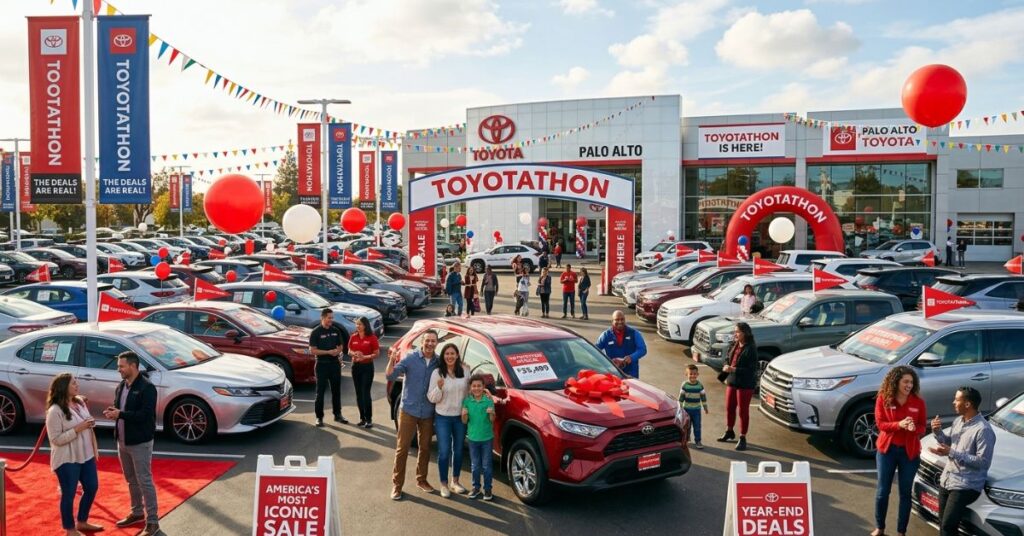

Every November, something predictable happens across American television screens. Between football highlights and holiday recipe segments, a familiar word surfaces — Toyotathon. For some viewers, it’s background noise. For smart car shoppers, it’s a signal worth paying attention to.
But what exactly is Toyotathon, why has it outlasted virtually every other promotional campaign in automotive history, and — more importantly — how do you actually benefit from it? This guide breaks it all down.
The Name Says It All
Toyotathon is a mashup of two words: Toyota and marathon. That combination isn’t accidental. Unlike a one-day flash sale or a weekend blitz, this event is designed to run for weeks — giving buyers time to research, compare, and commit without pressure.
At its core, Toyotathon is Toyota’s flagship year-end buying season, during which the automaker and its dealership network roll out a coordinated set of financial incentives aimed at accelerating vehicle sales before December 31st. Think of it as the automotive equivalent of a season-ending clearance — except the “clearance” involves cars worth tens of thousands of dollars, not last season’s jackets.
Born in 1969: A Marketing Campaign That Refused to Die
Most advertising campaigns have a shelf life measured in years, sometimes months. Toyotathon has been running since 1969 — more than five and a half decades. That kind of longevity in consumer marketing is virtually unheard of.
When Toyota introduced the concept, the American auto market was a very different place. Japanese brands were still building credibility with skeptical US consumers, and Toyota needed a way to close out each year with momentum. The solution was to create a named, recurring event that shoppers would remember and return to.
It stuck. Over the following decades, Toyotathon became embedded in American seasonal culture — as associated with the holiday period as department store sales and year-end countdowns. More critically, it gave Toyota a consistent annual narrative: reliability on the road, and reliability on savings.
The campaign’s durability also shaped the broader industry. Competitors watched Toyota’s success and launched their own variations. Honda, Ford, Hyundai, Chevrolet — virtually every major automaker now runs some form of a branded year-end promotion. But none of them came first. Toyotathon did, and that heritage still carries weight.
When the Sale Window Opens
Toyotathon doesn’t operate on a fixed date, but its rhythm is highly predictable. The event typically launches in the third week of November — often around the 19th — and extends through the first few days of January, usually wrapping up around January 5th.
That window is deliberate. It brackets the entire holiday shopping season: Black Friday, the December paycheck cycle, Christmas, and New Year’s Eve. These are weeks when American consumers are already in a purchasing mindset, when year-end bonuses hit bank accounts, and when the psychological appeal of starting the new year with a new car is at its strongest.
For dealers, the math is equally compelling. December is crunch time for hitting annual sales targets tied to manufacturer bonuses and performance incentives. A dealer who falls short of quarterly quotas in December has real financial motivation to deal — and that motivation often works in the buyer’s favor.
What the Event Actually Offers
Toyotathon isn’t a single discount applied uniformly across all vehicles. It’s a layered set of incentive programs that combine national manufacturer promotions with individual dealer-level adjustments. Understanding the layers is key to knowing what you’re actually getting.
Reduced financing rates are typically the most valuable component for buyers who plan to take out a loan. Toyota Financial Services periodically offers below-market interest rates during the event period — in some years dropping to exceptionally low APR tiers for buyers with strong credit. On a $35,000 vehicle financed over five years, even a two-point difference in interest rate translates to hundreds, sometimes over a thousand dollars, in total savings.
Manufacturer cash rebates offer a more direct form of savings — a fixed dollar amount knocked off the vehicle’s purchase price at the point of sale. These tend to be more prominent on models with softer demand or higher inventory levels, while top-sellers may see smaller or no rebates at all.
Lease incentives lower the cost of monthly payments by adjusting the residual value or money factor on lease agreements. Shoppers who prefer leasing over buying often find Toyotathon-period lease terms more favorable than what’s available mid-year.
Bonus cash programs sometimes stack on top of base rebates, particularly for buyers who choose Toyota’s own financing arm or who bring a qualifying trade-in vehicle.
Dealer-added promotions sit beneath all of the above. Individual dealers can layer their own inventory-clearing incentives on top of manufacturer programs, especially on vehicles that have been sitting on the lot for extended periods. These localized deals are frequently the most impactful — and the least advertised.
Which Vehicles Get the Best Treatment?
The Toyotathon umbrella covers nearly every model in Toyota’s lineup, but not all vehicles benefit equally. The general rule: the more inventory a dealer has of a particular model, the stronger the incentive to move it.
Sedans like the Camry and Corolla are historically strong candidates for financing deals, partly because they face stiffer competition from other brands and partly because they’re produced in high volumes. The RAV4, despite being America’s best-selling SUV for several years running, often sees more modest discounts on its standard version — though hybrid variants tend to have even less room for negotiation due to persistent demand.
Trucks like the Tacoma and Tundra can present good opportunities, depending on trim and configuration. The less-popular configurations on a dealer’s lot — specific color combinations, higher trims that have sat unsold — are where buyers willing to be flexible on specs can find real value.
Toyota’s expanding hybrid and electrified lineup — the RAV4 Hybrid, Corolla Hybrid, Grand Highlander Hybrid, and others — is worth watching during Toyotathon, though buyers should temper expectations. Strong consumer demand for fuel-efficient vehicles often means manufacturers have less urgency to discount them heavily.
Reading Between the Lines: What Toyotathon Won’t Tell You
Here’s something the commercials won’t mention: Toyotathon is, fundamentally, a marketing event as much as a savings event. The bright visuals, the seasonal music, the urgency of “limited time” messaging — all of it is designed to create momentum and encourage purchases that might otherwise be delayed.
That doesn’t mean the deals aren’t real. Many of them are. But a buyer who walks in without preparation and accepts the first offer on the table may not be getting significantly more than they would in, say, August.
The buyers who extract the most value from Toyotathon are the ones who treat it as a favorable negotiating environment rather than a guaranteed discount. They arrive knowing the invoice price of their target vehicle, they’ve already received competing quotes from multiple dealers, and they know which specific incentives Toyota is currently offering nationally — information that’s publicly available on Toyota’s website before any dealer conversation begins.
Toyotathon amplifies the results of good preparation. Without that preparation, its impact can be modest.
A Smart Buyer’s Approach to Toyotathon
Getting the most out of Toyota’s year-end event comes down to a handful of practical principles:
Start with data, not the dealership. Toyota publishes its national incentive programs publicly. Before you step foot in a showroom, you should know exactly what manufacturer-backed offers exist for your target model. That knowledge removes one layer of information asymmetry from the negotiation.
Negotiate the full purchase price, not the monthly payment. Monthly payment framing is one of the oldest tools in automotive sales because it obscures the total cost. Always anchor the conversation on the out-the-door price — the complete sum you’ll pay including taxes, fees, and any add-ons.
Let dealers compete. Toyotathon is a national event, which means multiple dealerships in your region are all under the same pressure to hit sales numbers. Getting written quotes from three or four dealers gives you real leverage — not theoretical leverage.
Timing within the event matters. The final days of December represent the highest dealer motivation. Quota deadlines, monthly targets, and year-end pressure all peak simultaneously. If your schedule allows, shopping in the last week of December often yields better results than shopping in November.
Be flexible on specs. The vehicle sitting on a dealer’s lot that matches exactly what you want — except in a color you weren’t considering — may come with a significantly better deal than the one they have to order or transfer from another location.
More Than a Sale: Toyotathon as a Cultural Artifact
It would be incomplete to discuss Toyotathon purely in terms of discounts and financing rates. After 55+ years, it has become something larger than a sales event. It is one of the few corporate marketing campaigns that has genuinely woven itself into the fabric of American seasonal life.
The imagery is familiar even to people who have never bought a Toyota: oversized red bows on hood ornaments, snowy driveways, families receiving cars as gifts. These visuals didn’t just sell cars — they shaped how millions of Americans imagine what receiving or giving a vehicle as a present looks like.
There’s also a sociological dimension worth noting. Toyotathon arrived at a time when Japanese automakers were fighting for credibility in a market dominated by American manufacturers. Its persistence and growth over the following decades mirrors Toyota’s own rise from scrappy import brand to the world’s largest automaker by volume. The campaign and the company grew up together, each reinforcing the other’s presence in American consciousness.
The Bottom Line
Toyotathon is real, it has history behind it, and it can represent a genuine window of opportunity for buyers who are ready to take advantage of it. The manufacturer-backed incentives are legitimate, the dealer motivation is real, and the timing aligns well with natural purchasing triggers.
But it rewards preparation. The buyer who arrives informed — knowing prices, knowing incentives, knowing how to negotiate — will always do better than one who shows up simply because they saw a commercial. That gap between the passive shopper and the prepared one is where Toyotathon’s real value either materializes or evaporates.
Go in with your homework done, and Toyotathon can be one of the smartest times of year to buy a Toyota. Go in cold, and you’re mostly just buying into the marketing.
Conclusion
Toyotathon has endured for more than half a century because it succeeds on two levels at once: it works as marketing, and it works as a sales strategy. For Toyota, it creates urgency and brand visibility during the most competitive shopping season of the year. For consumers, it can provide meaningful opportunities to save through financing offers, rebates, lease incentives, and dealer-level negotiations.
Yet the event is not a magic shortcut to a perfect deal. The real advantage belongs to buyers who approach Toyotathon strategically — researching incentives beforehand, comparing dealer quotes, negotiating the total vehicle price instead of monthly payments, and timing their purchase carefully. In that sense, Toyotathon is less about automatic discounts and more about creating the right market conditions for informed shoppers to gain leverage.
Its cultural staying power is equally remarkable. What began in 1969 as a year-end sales campaign evolved into one of the most recognizable traditions in American automotive advertising, influencing how the entire industry markets vehicles during the holidays. Few campaigns in modern business history have maintained that level of relevance for so long.
For anyone considering a Toyota purchase, Toyotathon remains one of the strongest buying windows of the year — not because every deal is extraordinary, but because preparation combined with year-end dealer pressure can create genuine value. The smartest buyers understand that the commercials may spark the opportunity, but informed decision-making is what ultimately turns Toyotathon into real savings.